Monday, February 25, 2008

Let's go see the Source of water

We still fit two more bodies in the back of this truck before we headed to thewater source.

We went to find Dominique and Jewells (ADIR engineer) so we could head up to the water source. When we found them the whole water committee was waiting and wanted to go with us to the source. We didn’t know where we were going to put them but Farrell said it was their project so they better go with us. We piled ten people in the back of our 4X4, 5 on each side and three in the front seat. We realized that our commvie dream ride was coming true. We were getting to ride in a commvie at last (see previous blog). We were packed in and actually it was somewhat easier as you bounced off of each other rather than the sides of the truck ,as you went over the terrain. Across from Farrell sat Maree Josee (Yes, she is one of the water committee ,a real community advocate). Our legs were all tightly bunched side by side and Marie’s legs were between Farrell’s We went over a big bump and everyone went flying and Farrell grabbed Marie's knees to keep her in place and keep her from coming on top of him. She cracked up and Farrell told her she needed to stay on her side of the truck. That really cracked her up.


We traveled through 4 villages. We stopped in each village and the people came running. The government water engineer told the crowd that the water project had been approved and would start very soon. There was much yelling and singing and tongue warbling (if you have been to Africa you know what that is). Everyone was very excited. This will be such a blessing to all of these people . Approximately 200,000 people will benefit from this water.
Walk from here!


When we got to the top of the hills we thought that Omer would stop and we would walk up but he just kept on trucking and we were bouncing up the mountain, a real four wheeling experience. He finally gave up and we got out and walked. The source is down a ravine and the hill we walked down was very steep with footholds to stick your feet in. I knew if I started to fall I would just roll to the bottom. We had an entourage of village children who had followed us up and so there was quite a crowd with all of us , the water committee, the ADIR team and all the children. We reminded ourselves that people walked this trail everyday with 60 lbs of water on their head.


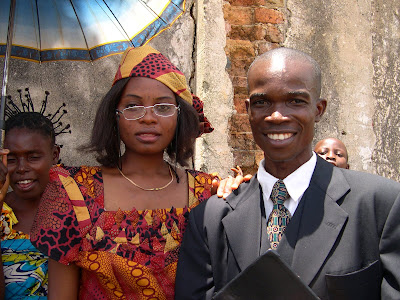
The Water Committee


This is the owner of the property where the source is located. He was carrying a machete to clear his path through the brush.


Elder Frandsen pronounced the water source as good and strong as before and everyone had a drink of the beautiful water. Well almost all of us. Some of us stuck with the bottled water.

There are three sources they are going to capture and pipe to a large reservoir and then the water will gravity feed down to 4 villages ending in Luputa. The source is large enough to give a good flow all the way down. What a blessing water is. We just keep thinking about the mothers who have to spend so much time getting water for the family and how much easier this process will be and the gift of time it will give to families when a large chunk of their day can be devoted to something other than getting water.


Well, when you go down you have to go back up and so now we had to hike back up that steep climb. I started up doing pretty good when all of a sudden our site manager, Daniel, came up beside me and said something in French. He grabbed me by the wrist and started hauling me up the mountain. I could hear Farrell laughing down below me saying Daniel’s responsibility is to always take care of Sis. Barlow. Now this boy was moving. He had me climbing at top speed. My butt was burning but I didn’t dare slow down as he was moving and I knew I would get dragged so I just kept climbing. This was like climbing up a step ladder. By the time we got to the top I could hardly catch my breath and I was gasping for air. Daniel got a good laugh out of that and at that point I felt my legs turn to rubber. Daniel has been doing those bicycle trips to market and he looks like one solid muscle. Farrell forgot to tell him I have very little muscle.
Second source


We all felt so rewarded for our trip. The project was on its way. We had our site manager. The people had been told and were overjoyed at the prospect. The water committee was ready and the source was as good as ever.

Robert could return to SLC and report that all is well in Luputa and calm the fears of all those who are worrying about the $2.7 million dollars being spent on a water project in a little village in Africa.
My partner on the hike


ADIR Engineer who will manage the project

Sunday, District Conference

District conference
Next day was Sunday and District Conference for the church. We knew there would be a crowd. The chapel is small so a bowery was set up outside and televisions set up so people could see the speakers. A large section in the chapel was reserved for dignitaries as the church expected that the police, government officials and the water committee would come. The Territorial Administrator came and sat on the front row with his wife. The meeting was wonderful, spiritual and an experience. There was a youth choir and when they broke into the Hallelujah Chorus it brought tears to our eyes.
Farrell was asked to speak in the conference about the water project. He explained to everyone where the humanitarian funds come from, that they are the widow’s mite. The gift of water is a gift from a loving heavenly Father who wants his children to be happy. We are all God’s children and we should take care of each other. He explained that the water project is not the church’s project but the communities project and would require the community to work to make it successful. The water would not belong to the church, it would belong to the community and they would have to care for it and use it wisely.

After the church meeting was finished. Pres. Benini invited the dignitaries to speak to the congregation. The Territorial Administrator said they had been hoping for this blessing for a long time and he wanted to thank the church for accepting the project and making it happen. This would help the community become stronger.
The police came to conference and he did bring his gun (he was acting as the body guard for the Terretorial Director.
The dignitaries adjourned to the other building for a reception where they were fed by the Relief Society. Protocal must be preserved a and food is a big part. First you do business and then you share some food; a pretty standard way of conducting business here.


That night we took a walk around Luputa. We had an entourage of children who would not allow us to take pictures without their jumping in front of the camera so we had to put the camera away and sneak it out and snap a quick picture.
We met a girl with a chicken basket
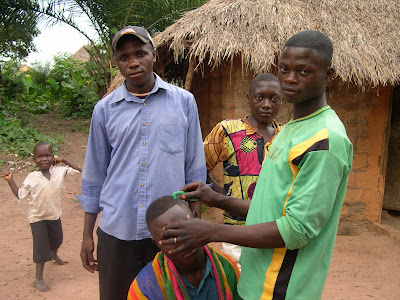
a man getting a haircut,
a family milling cassava flour and corn meal,
a boy playing with a homemade soccer ball,
several women coming back from the market.
We found a cattle truck sitting on the side of the road and before we knew it all the children had climbed on board.
We took a final picture of our entourage in front of the mission


Saturday, February 23, 2008

Luputa - Time to go home

Time to go home. We packed up and headed back to Mbuji Mayi where we would spend the night before flying back to Kinshasa. The roads had not improved any since coming if anything they were worse because of the heavy rain.


We stopped along the side of the road and parked in a yard to have lunch. Our driver Alphonse, went to turn around and backed into a field of tall grass that was pretty steep and then couldn’t get out we were stuck fast. We all climbed out of the back of the truck and the guys tried pushing him out to no avail. Sis. Livingstone started fixing lunch in the back of the other truck, cutting avocadoes in half and filling them with tuna. She had all the avocadoes cut and laid out on the seat when a big truck loaded with people and produce came by, stopped and offered to help get the truck out. They had a tow rope so they tied the rope between our two trucks and with Sis. Livingstone fixing lunch in the back they slammed the door and started bouncing and maneuvering around to pull the other truck out. It all happened so fast but the picture I didn’t get was Sister Livingstone catching air in the back of the towing truck and the avocadoes flying everywhere. She assured us as we ate our lunch that not one avocado hit the floor but we fell down laughing as she bounced around in the back trying to keep the avocadoes in place and yelling at the top of her lungs, “Wait, wait, the avocadooooooooos!”.

The family living where we decided to picnic were very gracious. They let us take their picture and use their latrine. A young boy took me to the latrine and then squatted showing me how to use it. The larine was a hole iin the ground but was surrounded by a small hut made of twigs with a thatched roof. Not as bad as I thought it would be. This was a first for me. Their yard was very clean and they had beautiful vegetable gardens and fruit trees. We shared some cheese wedges with them and some granola bars and candy. They loved the treats and the adults were as excited as the kids.

We braved the restaurant at the Hotel in Mbuji Mayi and slept on a bed that formed to your body and would not allow you to turn over without a great deal of effort. Our adventure was coming to an end and we were so pleased with all that was accomplished during our time in Luputa. Now all that was left to do was sign the contract with ADIR and get going.

What a choice experience we had meeting wonderful people, seeing more of God’s beautiful world and bonding with our fellow missionaries and leaders. We will make this trip at least two more times during our mission and we will look forward to the experience.


Monday, February 18, 2008

Wheelchairs! Wheelchairs! Wheelchairs

Wheelchair Distribution Project

After 6 months of work we finally got to distribute wheelchairs to handicapped people who are unable to afford their own chair.

Last June we started looking for someone who could manufacture tricycle wheelchairs here in Kinshasa. We had our morning prayers and asked Heavenly Father to help us find someone that could help us in finding a good partner. That afternoon Dr. Meliela, an OBGYN doctor here in Kinshasa (also the 1st counselor in the Mission Presidency) came to our office on his way to a meeting and said he thought he ought to introduce himself to us and offer his help. We told him about trying to find someone to manufacture wheelchairs and he gave us the name of a medical supply distributer and also the director of a local handicap center. We told him we had been praying for someone to guide us in the right direction and here he was.

We met with both facilities and ended up using the supply house as the resource for making the hospital beds for the handicap center (see previous blog) and then partnered with the handicap center for the wheelchairs.


The handicap center is very knowledgeable about making the tricycle wheelchairs as they have been doing it for the last 20 years. They have revised their design to meet the needs of the rough terrain here in the Congo and have upgraded their materials so that the chairs are sturdy and last a long time.

The church wanted to supply wheelchairs to people who were unable to afford their own chair. The social work department at the center screened all the candidates to make sure that they were indeed dependent on donations to get a chair. The cost of each chair was $330, well beyond most budgets when they are struggling to buy food to survive. The church usually looks at paying $150 per chair in other countries but in the Congo the price is higher. Supplies for the wheelchairs, wheels, sprockets, gears, etc. are brought in from Belgium and Germany. The church had funded 50 wheelchairs as a trial to see if the center could come through with a quality wheelchair.

The day was sunny and hot. We expected 25 recipients to show up for the chairs. The problem of transportation precludes many people from coming to the center to receive their chair. The staff had decorated the area where the chairs were to be distributed with flowers and bright Congolese fabric. The hospital administration gathered along with the Stake President (Pres. Iyomi), Area Authority (Elder Kola), Mission President (Pres. Livingstone), Dr. Muliela (our mentor) and missionaries assigned to Kinshasa.. We had asked the young missionaries to come and help distribute the wheelchairs.

Pres. Iyomi presented the wheelchairs to the recipients telling them the reason the church was giving them a chair. He told them that we are all children of our Heavenly Father and that we should help one another in carrying our burdens and strengthen one another to reach our potential.

John Baptist, Hospital Director, addressed the recipients and told them that the wheelchair was their opportunity to become independent and productive. They should not waste this opportunity but seek ways to improve their lives and bless their families.

Each recipient signed a register acknowledging receipt of their new chair and then they were helped into their chair by hospital staff, church dignitaries and the young missionaries.

One proud young man came up and the staff reached to help him but John Baptist held them back and told them to give him some dignity and we watched him struggle to get into his new chair. Once he was in his chair he grinned real big and waved at everyone, gratitude written all over his face.

There was much happiness, many tears, high fives and joyous clapping from the people as they wheeled themselves away and realized the value of mobility. There were many tears shed by those who witnessed this miracle and everyone felt blessed for having had the experience.

We presented the check for the wheelchairs to John Baptist and breathed a sigh of relief that the work of the last 6 months had finally produced the outcome of helping people in need. We were so pleased with the work of the handicap center staff: pleased with their ability to make a good strong wheelchair, pleased with their screening process to find the most in need, and their graciousness in accepting the sacred humanitarian funds for such a worthy project.

On Sunday in the fast and testimony meeting in the Limite Ward, one of the recipients bore his testimony. He said that he had been given many blessings since joining the church. This week a great blessing had come to him because of his membership. He had been given a wheelchair from the church sponsored distribution. He was poor and he never felt he would ever be able to afford a wheelchair and here today he had a wheelchair. That was only one of his blessings since he became a member and he was very grateful for the love of Heavenly Father who knew who he was and was mindful of his needs.

The stake Presidents were asked if there were members in their stakes who were handicapped and would benefit from a wheelchair. We were given 6 members names that we asked the handicap center to screen for receiving a wheelchair. This man was one of those recipients.

This day of distribution was a great payday for us and one we will never forget. We hope to repeat it again before we return home. The center has an endless list of people who need these wheelchairs and they are grateful for the support that the LDS church is willing to give to help them meet their goals for caring for the handicap.

We are grateful to find such a good partner as the handicap center that is doing so many good things.


Tuesday, January 29, 2008

An Oasis For Health Care in the DRCongo


The process of choosing humanitarian projects for the church requires that we partner with NGOs (registered non-governmental organizations). Once you have found a good NGO then you have to design the project so that it strengthens the organization and leaves it stronger and more able to meet the needs of those they service. The difficult part of this mission is finding those NGOs and then writing up the project so that it is not just giving things but meets the goal of helping the organization become a stronger and more viable organization.

One of the major initiatives of the church’s humanitarian services is providing wheelchairs for the h
andicapped who are unable to afford a wheelchair. Soon after coming to Kinshasa we went looking for an NGO to partner with who could make wheelchairs, the tricycle wheelchairs needed for the rough terrain here in Kinshasa. We visited a rehabilitation, handicap center. This center is run by the Freres de la Charité, a Catholic organization.

This center is an amazing place. Monday, Wednesday and Friday is clinic day and the center is packed with patients and family coming to clinic. The center is a large complex with several buildings connected with walkways. The buildings are open to the outside and the waiting area is all outside around the walkways. They have a clinic, physical therapy, optical shop, wheelchair manufacturing, prosthetics manufacturing, surgery, social work, and a vocational training center. The complex is clean and well maintained which was very refreshing to see as that is not the normal case for health centers here in the Congo. Over forty percent of their employees are handicapped like the wonderful man who maintains the main gate and keeps the parking area swept clean. He has no hands. Another man working in the main office is confined to a stretcher. He is very gregarious and always makes us feel so good when we come to the center. The directors secretary uses two canes to get around and always has a big smile for us when we visit.

John Baptist Musawu is the director of the center. He is a small man exuding energy. He walks with a bounce and he moves very fast. He is cheerful and bright and always positive making him a perfect representative of this center.

When we first started talking to John Baptist we asked him for a wish list of things that the center desperately needed. At the top of their list was patient beds for surgery recovery.

We went to look at the beds and found them to be deplorable, especially for surgery patients who desperately need a sanitary place to recover from extensive orthopedic surgery. The beds were flat, rusted and the mattresses were bare pieces of foam that didn’t allow for cleaning between patients. The rooms were tiled and the walls were in good shape but needed painting. The center wanted to upgrade the rooms with new beds and vinyl covered mattresses that could be cleaned appropriately when soiled and sanitized between patients.

Since we don’t just give gifts to associations we needed to find a way to strengthen the organization to make this a project worthy of humanitarian funds. We wondered how the patients did after going home to finish their recovery and wondered if the conditions for recovery were adequate or was the hospital seeing much infection after surgery. We have had great success with the church’s program of Family Health and Hygiene and wondered if it could be applied to post op teaching of these families and enhance the recovery process for these patients.

We worked with the social workers to see if they would be interested in the Family Health and Hygiene training and they were very receptive. We wrote the proposal to include 40 new beds and mattresses and 100 each of the Family Health and Hygiene manuals and 100 supplements which are the picture book of the FHH program. Both manuals can be used to educate professionals, parents and children in how to improve nutrition, teach proper hygiene practices and educate on prevention of disease.

The project was approv
ed by the Area Authorities and we immediately ordered the beds and the printing of the manuals. We delivered the manuals to the Social Work department so they could get started teaching. They organized open classes and are teaching post op patient families and also families that are coming to the clinics.

We had to order the beds from a supply house here in Kinshasa. The beds are very simple but they are of the type that will work great here. The beds can’t be electric as the electricity is not dependable. The beds are metal frames with metal springs. The one end of the bed can be manually raised and lowered to accommodate the raising of the foot of the bed or for raising the head of the bed. The mattresses are foam covered with vinyl.

At the handicap center patients come in the day of surgery and then stay at the hospital from 3 days to a week or more. During their stay the family is responsible to stay with the patient and provide food and clean linens and clothing. They come to the center with cooking utensils and a bucket for washing clothes and bedding. There is always linen hung out to dry just outside the patients rooms.

During our visits to the center we have run into a man who has brought his son in for surgery 3 different times. He is
from out of town and has no money but wants to help his son be able to walk so brings him in to get the needed surgery. He sees us coming and asks if we can give him some money to buy food for his son. We have given him a few francs each time and he immediately goes out on the street and buys food from a vendor and brings it back to his son. We find ourselves worrying about him when we don’t go to the center and wonder how he is feeding his son. This is typical of the families here at the handicap center as they are all poor and are trying to survive and care for their handicapped family member. The handicap center evaluates each patient’s family for financial resources and charges the patients according to their ability to pay for the services. That is one of the jobs of the social workers. The center is dependent on charity dollars to serve the poor.

On January 11th we had our ceremony to give the beds to the center. Pres.Iyomi, Stake President of the Kinshasa Stake gave a speech donating the beds and training materials to the center in behalf of de Église de Jésus-Christ des Saints des Derniers Jours (The Church of Jesus Christ of Latter-day Saints). The Director, John Baptist spoke. He said it usually takes a lot of talking and finessing to get things done but this bed project happened quickly.
Now the center will have proper beds for their surgical patients. The prayer given at the ceremony acknowledged that we are all family and we should think of and help each other. Our church really does believe this and the humanitarian services practices this belief in trying to serve and help all of God’s children.

We visited the patient rooms to view the beds in service and were delighted to see the rooms had been scrubbed and painted. The beds did indeed create a much more sanitary environment for the patients and the ability to raise the foot of the bed was enhancing the care of the patients as they had their foot or leg raised to reduce the swelling to the surgical site and promote healing. The Family Health and Hygiene classes are in full swing and will continue indefinitely.

We have fallen in lov
e with the Center. We admire the people there and are grateful for such a good partner. We have other projects in the works with the center including a wheelchair project.
We are very busy trying to find ways to spend those Humanitarian dollars you keep paying to the church. Heavenly Father is mindful of us as we work here trying to do good things. We are being led and directed daily to good partners and wonderful people. We are blessed with good health and safe keeping each day. Would you like a wonderful experience. Come on a mission!